Art and the Unexpected

“Comfort Ye My People”

From The Gospel Messiah (Too Hot to Handel)

George Friedrich Handel

Marin Alsop and the Colorado Symphony

Orchestrated by Bob Christianson and Gary Anderson

Art and the Unexpected

Painting, mostly in blue, of the Lights

Northern Lights

Anna Boberg,

https://en.wikipedia.org/wiki/Anna_Boberg#/media/File:Northern_Lights,_by_Anna_Boberg.jpg

Maria Popova wrote about John Cage in “Nothing: The Illustrated Story of How John Cage Revolutionized Music and the Art of Listening. “The essay focuses on Cage’s composition “4’33”. The composition was written for piano, but I have seen it performed on the violin as well. In this piece of music, the pianist sits down at the piano, or the violin, or whatever instrument the piece has been orchestrated for, and does nothing for four minutes and thirty-three seconds. The fact that the piece has been orchestrated for different instruments suggests that silence sounds different on different instruments as well as in different places. The article asks us to consider what is music and silence and if they can be the same. It asks, what is the nature of silence? The music of Cage’s piece is created by the place and the people in that place. As there is no perfect vacuum, no space totally devoid of air, is there a space totally devoid of sound? First “performed” by the “virtuoso pianist David Tudor in a barn-like concert hall in Woodstock, New York — four minutes and thirty-three seconds of pure silence, suddenly rendering musical the ambient sounds of ordinary life.” And those ambient sounds are everywhere different. One thing the history of this composition teaches us is that silence can be copyrighted. The rock composer Mike Batt of the rock group “The Planets” was sued for copyright infringement. His song “One Minute Silence,” it was alleged, was stolen from Cage’s 4’ 33”. Batt paid a pretty large sum of money to settle the suit; it would seem it is the idea behind the composition as much as the composition itself that is copyrighted. I have a Nitty Gritty Dirt Band CD that, as you might expect, goes silent after what was listed as the last song. But I was working while listening and I couldn’t put on another album right away and after a minute or two another song, “The Weight,” played that was in fact the last song. The “silent track” unfortunately was not listed on the albums list of songs, and neither was “The Weight,”, so how was one to know? Perhaps to list the silent track would cause copyright problems.

But silence is different everywhere. When I work, I work in silence because it is easier to concentrate. But I am never really in silence. I hear the sounds of my fingers on the keyboard. I hear birds in the yard. I hear the wind in the trees. Wallace Stevens captures this kind of silence in “The Idea of Order at Key West”:

If it was only the dark voice of the sea

That rose, or even colored by many waves;

If it was only the outer voice of sky

And cloud, of the sunken coral water-walled,

However clear, it would have been deep air,

The heaving speech of air, a summer sound

Repeated in a summer without end

And sound alone.

In the poem a woman is singing, but Stevens is describing the sounds absent the woman’s voice. He is dismissive of these sounds, suggests it is the woman’s voice that brings them into being. But the sound of the silence as described by Stevens is beautiful in itself. It might be what we would hear if Cage’s 4’33” were played at this beach in Key West. Sometimes we take the sounds of silence that surrounds us for granted, we are dismissive of them. If we think about Cage’s composition, it suggests there is more to most things than we realize when we think of them simply. The article said, “For Cage, the questions were always the important part, because the questions were more interesting than the answers. The questions often led to more questions, instead of answers.”

The music at the top illustrates another way music can take us by surprise. The song is from Handel’s oratorio The Messiah. It is a piece of music most are familiar with, and this vocal is one most have heard. But instead of the baroque orchestrations and vocals we expect to hear; it has been orchestrated for a gospel band with gospel choir and soloists. We hear saxophones, organs, trumpets, guitars and such instead of strings, woodwinds, and brass. The conductor, Marin Alsop, wanted to perform The Messiah in a way that would bring people to their feet the way the original performances did. She thought orchestrated for a gospel band and chorus the music would be more rousing to a modern audience. There is more to a piece of music than the notes.

Painting of men being shot by a firing squad

The Third of May

Francesco Goya

https://en.wikipedia.org/wiki/Francisco_Goya#/media/File:El_Tres_de_Mayo,_by_Francisco_de_Goya,_from_Prado_thin_black_margin.jpg

In “Art Isn’t Supposed to Make You Comfortable” Jen Silverman writes of a book she read in college:

When I was in college, I came across “The Sea and Poison,” a 1950s novel by Shusaku Endo. It tells the story of a doctor in postwar Japan who, as an intern years earlier, participated in a vivisection experiment on an American prisoner. Endo’s lens on the story is not the easiest one, ethically speaking; he doesn’t dwell on the suffering of the victim. Instead, he chooses to explore a more unsettling element: the humanity of the perpetrators.

This merits thought. We should care about victims and do all we can to alleviate their pain and to prevent the causes of that pain. But prevention probably requires us to pay some attention to the perpetrators, they are after all the ones that need to be changed if the world is to be improved. She goes on to say, “When I say ‘humanity’ I mean their confusion, self-justifications and willingness to lie to themselves. Atrocity doesn’t just come out of evil, Endo was saying, it emerges from self-interest, timidity, apathy and the desire for status.” What Hannah Arendt called the “banality of evil.” She said this of Adolph Eichmann, the Nazi war criminal. Arendt said he was a “normal man,” a “boring man” who was “only looking for advancement.”

Silverman goes on to talk about a visit she made to a web site that trashes books the contributors to the site do not like, books like Lolita, Paradise Lost, and Rabbit Run. The reviewers did not like the books because they revolved around characters the readers thought despicable and why do we need to read about such people. Silverman suggests why, “Here on my screen was the distillation of a peculiar American illness: namely, that we have a profound and dangerous inclination to confuse art with moral instruction, and vice versa.” Of course, there is a sense in which these books do provide moral instruction, in that they confront us with behaviors we as a culture need to address. It is in this sense that literature and art ought to work:

But what art offers us is crucial precisely because it is not a bland backdrop or a platform for simple directives. Our books, plays, films and TV shows can do the most for us when they don’t serve as moral instruction manuals, but rather allow us to glimpse our own hidden capacities, the slippery social contracts inside which we function, and the contradictions we all contain.

Literature opens our eyes to the world that is. Many, maybe most, Utopian books point out not what the best possible world looks like, but the shortcomings to the best possible worlds we imagine. This is an important function of all art, it challenges us, makes us think about things, to not take the good things, the beautiful things of our world for granted and consider ways to fix what is problematic. It also helps us understand that what is problematic for us may not be problematic, or harmful, for others. It helps us consider how we accommodate everyone.

Cage draws attention to what silence sounds like and we should consider if this is what silence should sound like and if it is we ought to take an interest in preserving that sound. How has the sound of silence changed over the years since Cage composed 4’33”? There is an old Loving Spoonful song, “Summer in the City.” Part of the song’s accompaniment is jack hammers pounding in the background. If 4’33” were played in the city, jack hammers and police sirens and the like would be part of the ambient sound. Should those sounds be preserved? How would life in the city change if these sounds were eliminated? There are sounds that are unpleasant but are also important to the maintaining of a society. Spike Jones used to orchestrate pistol shots that fired in the key of the song his band was playing. He did this with other kinds of racket as well.  Noise can be musical. Not all background noise is as pleasant as the ambient sounds surrounding a barn or a concert hall. But they may be necessary none the less. Spike Jones’ band suggests there are few sounds that can not be made musical.

All the arts much of the time draw our attention to what should be preserved and what should be changed. And not all of what should be preserved is pleasant.

 What I find to be important in books is how they help me to see more clearly what human experience is made of. I enjoy Jonathan Swift, Mark Twain, Ben Jonson, and others like them. They make us laugh, but, if we are paying attention, we realize the laugh is on us. The humor and jokes entertain us, the thoughts they provoke educate after a fashion. I think if the con artists in the film The Sting are placed alongside the con artists in The Adventures of Huckleberry Finn, they illustrate this point. In the film I find myself liking the con men, in part because they are conning someone who deserved conning. When we first encounter the King and the Duke in Huckleberry Finn, they are comic characters, and we laugh at what they do. Those that are conned are either foolish or cruel and, in a sense, deserve what they get. But they then con three young sisters who have been orphaned. These men try to con them out of everything they have and leave them to make their way in a world that offers them few ways of taking care of themselves. The kind of things the Duke and the King are doing are not unlike other things they have done, but in this instance, they are doing real harm. We are stopped up short if we are paying attention. What these men do to the sisters isn’t funny. I laughed when the harm being done was to people who deserved the harm. But these young girls did not deserve this. Twain forces us to consider if it is acceptable to cause suffering if it is to people we do not like; that hurting others is only a bad thing if the people being hurt, in our view, don’t deserve to suffer. But who are we to decide who does and does not deserve to suffer.

Perhaps reading, or viewing, this way, takes some of the fun out of it, but I believe Twain is inviting us to confront our behavior and the things we condone, if only by laughter. At the end of The Sting, I am on the side of the con artists and pleased they won. But what of the other people they con? Are those as deserving of what happens to them? At the beginning of the film a mobster, whose job it was to deliver the day’s take to the boss, is tricked out of the money he was supposed to deliver. As a result, he was killed. He was a gangster, he probably deserved it, but somehow, I am troubled by it. Also, they were going to con the first person they encountered, it only happened to be a gangster, but it could have been anyone. Perhaps the film maker wanted the audience to be troubled. But I don’t think so.

 Painting of a futuristic city that uses jet propulsion to hover over the surface of the land, as laputa did in "Gulliver's Travels.

The City of the Future

Frank R. Paul

https://en.wikipedia.org/wiki/Floating_cities_and_islands_in_fiction#/media/File:Science_and_Invention_Feb_1922_pg905_-_Cities_of_the_Future.jpg

In another book from another time, during the third voyage of Jonathan Swift’s book Gulliver’s Travels, “A Voyage to Laputa,” the wife of Laputa’s king runs away. Laputa is an island that floats above the surface of the land. The king, like most of the men on the island, is totally self absorbed. He treats his wife like a piece of furniture. So, she goes to the land below. She has a relationship with a footman who beats her. When she is captured and returned to her husband and the floating island, she runs away again to be with the footman who beats her. This is of course a very sexist joke, the woman is too stupid to stay where it is safe, even if it means being totally ignored.

But it could be argued that being treated like a piece of furniture is a kind of emotional, psychological abuse that denies her humanity. We all understand that physical abuse is abuse. But we can be dismissive of other kinds of abuse, like emotional and psychological abuse. Swift does not have to make a case that physical abuse is abuse, everyone knows and acknowledges that. But by seeing her return to the land where she is beaten, we are compelled to consider the emotional and psychological abuse she is trying to escape as abuse as well and that of the two she prefers the physical abuse. If she had stayed with the king, we would probably dismiss the form of abuse she suffers and think no more about it. We might accept that the abuse she suffers on the island is a valid reason for leaving the floating island, but why return to the footman. What else is she to do? On the island she lived an empty meaningless life where she was given nothing to do. When she reaches the land, she has no skills and no way to support herself. And even if she did have skills, at this time in history she may not have been given the freedom to put them into practice.

Swift, I am sure, was probably as sexist as most men of his time, and he probably intended the sexist joke as a sexist joke; he certainly wasn’t a feminist. It is not unlikely that I am reading all this into the text. But it is the text that suggests these thoughts, to me at least. Swift was a Humanist, and as a Humanist he may have considered thoughts like these; that people, men and women, need to do more than breath the air and take up space. Swift as a writer effectively used irony to provoke his readers. Maybe here he was being a bit provocative. These books entertain, but they can do more than that for the reader that is open to what the entertainment brings along with it.

Some years ago, Azar Nafisi wrote a book, The Republic of the Imagination. She is an immigrant from Iran. In the introduction she writes about a conversation she had with another émigré from Iran. He said American readers didn’t understand their own books. In Iran he did not have the freedom to read books Americans take them for granted, if they take them at all. He said, “These people are different from us – they’re from another world. They don’t care about books and such things. It’s not like Iran where we were crazy enough to xerox hundreds of pages of books like Madame Bovary and A Farewell to Arms.” Azari didn’t agree with the man, but perhaps there is something to what he says. Nafisi went on to point out that those that risk torture to read, listen to, or watch works of art “hold the whole enterprise in an entirely different light.”

In a place where the arts are available to anyone anytime they want to pursue them, for as long as they want to pursue them it may be easier to take the arts for granted. We are surrounded by them. People who do not like an artform, opera for example, may think those that like that artform odd, or elite, but no one’s right to indulge that artform is infringed. I can read Shakespeare or Marvel Comics, listen to classical or popular music, look at the paintings of Rembrandt or graffiti with no problems.

I read once of miners in Britain that maintained libraries on their work sites, libraries of Greek and Latin literature, as well as more contemporary thinkers and story tellers. Perhaps things are still a bit that way, that miners in this place and time are also stimulated by pursuits of the mind and imagination. Mind and imagination are wonderful things. Why did I find it surprising that miners once upon a time would value this when today the perception of miners is that their interests do not go far beyond sports and country music. This is not true of course, but popular culture likes to generalize and make it seem true. There is an old movie, The Corn is Green that revolves around a coal miner with an aptitude for scholarship who at the end of the film is sent off to college. The impression is that this miner is unlike all the others and all the others lack these intellectual gifts. Yet the miner’s libraries were prevalent at the time this film was set, which suggests these impressions may be inaccurate. The film does suggest that all miners’ children should have the opportunity to learn and prepare for college. That lack of training is not the same as the inability to be trained. These children did not turn their backs on education, they weren’t given the opportunity to get an education.

It seems at times we herd ourselves into our different “elites” and resist the crossing of elitist lines. Certain aspects of mind and imagination seem inappropriate, and we drive ourselves into our corners where we each pursue the avenues of thought that are open to our station. But St. Paul, who wrote two thirds of the New Testament was a tent maker. Grover Washington Carver began as a slave. Aphra Behn began as a spy who became a writer when the king refused to pay her for her work as a spy. The novelist Jack London began as the “prince of the Oyster pirates.” Charles Ives and Wallace Stevens were insurance salesmen when they weren’t composing music or writing poetry. Robert Frost was a farmer. The Bronte sisters were governesses, Jane Austen and Emily Dickinson were stay at home daughters. Zora Neale Hurston was n Anthropologist. Walt Whitman suggests we contain multitudes (or at least that he did) so why not explore more of those multitudes.

The Kingdom of the Fairies

George Méliès

Star Film

The film is from the silent era. Because color film had not yet been invented, each frame of the film had to be colored by hand. At 24 frames per second that must have been an arduous process. The film as originally presented was silent, there was not music playing behind it as there is in this video. If you want to experience the film as the original audience did, turn off the sound. Without the sound it takes on many of the characteristics of a ballet. Denis Villeneuve, the director of the most recent Dune movies, in an interview said he thought film should be viewed without sound, because the visuals for him are what is most important. He thought an earlier film version of Dune was brilliant when viewed as he viewed it without sound. It was the acting in the film that resulted in its poor reviews and ratings and perhaps if viewed visually, without sound, it is a more impressive film.

Perhaps, Cage in his 4’33” was trying to help audiences be more comfortable with silence.  Experienced in silence many may lose interest in this film and turn it off. But consider the color. It is not just that it was a difficult and time-consuming process to make this a color film, but that it is visually stunning. Remember, films are also called “movies” a word derived from what they were originally called “moving pictures,” because that is what they were, pictures that moved. I suppose being new, the magic of a moving picture, even if left in black and white, might be more engrossing for those that had never seen pictures move than they are for us. Imagine John Cage’s 4’33” playing for 16’44” as the soundtrack for the film; we can take Cage’s music into a new dimension. It might make it easier to watch with Cage’s music playing in the background. This may be an instance of art making us uncomfortable, but not because the subject matter is uncomfortable, but because the times and the form have changed. To view this, we need to look through the lens of the original audience. It is not the message but the medium that is uncomfortable. We have to grow accustomed to a different way of experiencing delight.

Painting of three men, a Renaissance European man, A Persian of Arab man, and a Greek man

Three Philosophers

Giorgione

https://en.wikipedia.org/wiki/The_Three_Philosophers#/media/File:Giorgione_-_Three_Philosophers_-_Google_Art_Project.jpg

What I find interesting about this painting is that it is of three men who live lives of the mind, who think deeply and should have much to share. But each one is engrossed in his own thoughts and seems totally self-absorbed. They also look to come from different cultures and different times. The first, starting from the left, appears to be European and a Renaissance philosopher. The second appears to be from a Persian or Arab culture, that was responsible for preserving Classical philosophy, science, math and literature during the “Dark Ages.” The third appears to be a Greek holding a document in his hands that looks scientific or mathematical, representing classical thought. It also suggests the route Classical thought took back into Europe during the Renaissance. It was lost in Europe with the rise of Christianity. However, it flourished and was preserved in Arab culture. As a result of European trade Classical thought found its way back into Europe. Still, the philosophers are not talking to each other.

In the “Dark Ages” Classical art, literature, and culture was shut out (though not to the extent that we often imagine) and the focus of education was on theology. As a Christian I find this period rich in a kind of thought, but without competing points of view and ways of thinking, I think theology became, if not weaker, disengaged from the arguments of its time in the rest of the world. I appreciate that Augustine kept Plutonic thought, Plato’s way of thinking, alive, and it was Augustine’s classical education that made him a Platonist. But it was here perhaps that Liberal Arts education first came under attack. It created a different kind of silence, the silencing of views that stretch one’s thoughts by challenging them. It was worse than avoiding those that think differently, because different points of view were muted. But wherever there is silence, something will fill it, heresies of one kind or another.  The argument over making education focus on what we need and not on other “unnecessary things” began. We can also see how the definition of necessary things changes with time. Today necessary things are not theological, but the sciences and mathematics and other useful avenues of instruction. It is still Art, Literature, Philosophy, and Culture that are seen as unnecessary, at least for those whose profession does not require these areas of study. It goes beyond this a bit in that unnecessary things are defined as those things that are unnecessary for one’s planned profession, which assumes students know what their profession will be before they enter college.

Harun Kücük and Ezekial J. Emanuel, define liberal arts instruction in their essay “Higher Education Needs More Socrates and Plato”:

By liberal arts, we mean a broad-based education that aspires to send out into society an educated citizenry prepared to make its way responsibly in an ever-more complex and divided world. We worry that at many schools, students can fulfill all or most of their general education requirements and take any number of electives without having had a single meaningful discussion that is relevant to one’s political life as a citizen.

Over the past century, what made American higher education the best in the world is not its superiority in career training, but educating students for democratic citizenship, cultivating critical thinking and contributing to the personal growth of its students through self-creation. To revive American higher education, we need to reinvigorate these roots.

They contrast this with the kind of education found in other parts of the world and that some advocate for the United States, “In Europe and many countries elsewhere, colleges and universities have undergraduates specialize from Day 1, focusing on developing area-specific skills and knowledge. College students are trained to become doctors, lawyers or experts in international relations, English literature or computer science.” In America, “Historically, students arriving on American college campuses spent a majority of their first two years taking classes outside their projected majors. This exposed them to a common curriculum that had them engage with thoughtful writings of the past to develop the skills and capacity to form sound, independent judgments.” This produces graduates that can think deeply and converse eloquently. It is true that doctors need to know medicine and lawyers need to know law, but we all need to know the workings of a democratic society and its institutions and how to talk intelligently and respectfully with those we have differences on politics and policy and values.

John Henry Cardinal Newman in The Idea of a University (first presented as lectures in 1852 and published in 1873) wrote, That the university “is a place of teaching universal knowledge. This implies that its object is, on the one hand, intellectual, not moral; and, on the other, that it is the diffusion and extension of knowledge rather than the advancement.”

But the urge is for education to be practical. President Obama suggested once that he found it difficult to understand why someone would pursue an advanced degree in Art History. He walked it back a bit, but this is a prevalent view in our society. Why pursue something so useless, at least in the economic sense anyway. The arts, to be appreciated, require us to look into art’s objects and consider their beauty and what they are trying to communicate, that, among other things, beauty has value. One of Thomas Aquinas’ proofs of the existence of God is “Gradation,” that there is a range to things. There is good and there is evil, there is beauty and there is ugliness, there is truth and there is falsity, and so on. There is also a range when these values are considered individually. Two things may be beautiful but one may be more beautiful than the other and we may not always agree as to which is the more beautiful. Also, what is true is different for an atheist than it is for a theist. These differences are not reconcilable but that does not mean we cannot talk respectfully and intelligently about how we each approach these differences.

Three Chinese men who have just crossed a bridge and are laughing.

Three Laughs at the Tiger Brook

Anonymous

https://en.wikipedia.org/wiki/Three_laughs_at_Tiger_Brook#/media/File:Huxisanxiaotu.jpg

The painting is from China and is of three men who are laughing. There is a story behind this painting. One of the three men is a Buddhist, one is a Taoist, and one is a Confucian. They were vigorously debating their different views, each trying to convince the others of the superiority of his beliefs. When they cross the bridge, they realize they had been in a tiger infested bit of land. They laugh because their debate kept their attention off the danger they were in. They were discussing deeply held beliefs and they, being theologians of sorts, enjoyed talking about those beliefs. This made their trip across this land of tigers pleasant instead of terrifying. They were in mortal danger the whole time. But because their talk made them unaware of where they were they enjoyed the journey. In a sense, we are in dangerous times and if we could learn to talk to each other and enjoy talking about our differences, the time will feel, and as a result, perhaps be, less dangerous. While discussing our views as friends we are not beating up each other.

We see this the world over, not just in America, that people cannot talk to each other. We see forces that want to silence those whose views differ from theirs. We see people defining tyranny as not getting their own way. In America, presidents are declared incompetent by their opponents if they pursue an agenda that doesn’t advance the agendas of their opposition, if it isn’t conservative, liberal or moderate enough as the case may be, like suggesting George Bush (take your pick which one) was a failed president because he didn’t advance a liberal enough agenda or Joe Biden is a failed president for not pursuing a conservative enough agenda. We should enjoy our difference because, in fact, that is where our true strength lies. For a diverse nation to be safe and strong it must accommodate those diverse views. When a democratic republic cannot do that, it is marching towards autocracy. I was born when Truman was president. Between Truman and Biden there have been fourteen presidents, seven Republicans and seven Democrats, that is what democracy looks like.

Kücük and Emanuel end their article:

Liberal arts education is not value neutral. That is why it is indispensable today. Freedom of thought, critical reasoning, empathy for others and respectful disagreement are paramount for a flourishing democratic society. Without them, we get the unreasoned condemnations so pervasive in today’s malignant public discourse. With them, we have a hope of furthering the shared governance that is vital to America’s pluralistic society.

There are people whose opinions are radically different from my own that I talk to, whose company I enjoy, and views I respect, and this feeling is mutual. And remember “liberal” when speaking of liberal arts and liberal democracy is not political, but identifies a free society, one with “liberty” as opposed to totalitarian or monarchal societies that place limits on liberty. In American society all politics is, in this sense, liberal. We are all free to be politically liberal when the government is conservative and conservative when the government is liberal. A liberal education helps us realize that we do not truly know what we believe and why believe it if we do not understand the opposing views and why we do not agree with those. Much of this comes down to conscience and core beliefs that are not and ought not be easily changed. Part of the problem is that views rooted in conscience puts other views in an unconscionable light. And if we are all to live freely and peaceably with a clear conscience, we have to learn to bridge our difference.

As a Christian I have to realize that non-Christians will find my views untenable, in fact other Christians whose theology differs from mine may also find my views untenable. Jesus told His followers they had to love each other and if someone outside the faith did not see that love, the outsider is free to conclude Christianity is not real, is not true (By this all people will know that you are my disciples, if you have love for one another.” John 13:35). It might also be suggested that people will know we are a democracy by the love we have for one another. This is something we see in practice whenever there is a disaster of one kind or another, as when everyone rallied around New York City after 9/11 whatever their politics and when everyone rallied around Louisiana and the rest of the gulf states after Hurricane Katrina. We help our fellow citizens when they are in trouble. When storms come to Massachusetts, I see trucks from Kentucky and Tennessee helping us with the cleanup. Though we may talk disparagingly about one another much of the time, we are there for each other in our times of need. That is what love looks like much of the time. We can look at the Good Samaritan as a Conservative Republican helping a Liberal Democrat he found in trouble by the side of the road. In the Cotton Patch Gospel, the man on the road is a white man and the man who helps him is black. This version of the Gospels was published in 1957, as the Civil Rights Movement was gaining momentum. Martin Luther King, Jr’s “Letter from Birmingham Jail” for example, was published in 1963. It was also, like many paintings of Gospel events from the Renaissance, set in the time it was written. “The Letter to the Romans” for example, is called “The Letter to the Washingtonians.” Cage’s 4’33” was about hearing silence differently, but there are many other things we need to hear and see and do differently

Painting of a man trying to put an injured man on a horse

The Good Samaritan

Vincent van Gogh

https://en.wikipedia.org/wiki/Conscience#/media/File:Vincent_Willem_van_Gogh_022.jpg
The Letter of the Law

Symphony No. 8 in C Minor, WAB. 108_ II. Scherzo (Allegro moderato) Trio

Anton Bruckner

Staatskeppelle Dresden, Eugene Jochum

The Letter of the Law

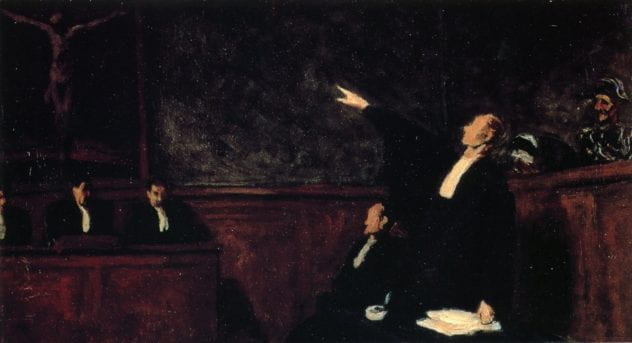
Lawyer standing in court speaking to the court while pointing to the gallery

The Court

Honoré Daumier

https://www.wikiart.org/en/honore-daumier/the-court

There is a way law and literature are connected. The same language used to write literature is used to write law; law uses the language literature grows. Time changes the meaning of words and in law words must be understood not as they are today but as they were understood when the law was written. There are conservative justices on the courts that limit the language of law to what it meant at the time it was written, considering less the principles the law was trying to capture and codify, where more liberal justices try to place a greater emphasis on those principles. If a word like “privacy” meant something different once upon a time or does not appear in law written once upon a time does that mean that there is no right to privacy. The first and fourth amendments of the U. S. Constitution are understood by some to provide guarantees of privacy, but the word privacy is not used. But some believe it to be implied in the language of the amendments. Some think there is no such implication, or if it is implied it is in a limited way. How do we apply 18th century thought to a 21st century world? How do we keep some from interpreting the language to support their privacy but not the privacy of others? Language and the understanding of language is complicated. I had a professor in college who did not believe we could understand the language of an earlier age in our own day, that over time language becomes meaningless, or at least meaningless to those outside the time it was written. If this is true, is it possible to interpret the laws made by those, not just hundreds of years ago, but of people a generation or two ago?

On the other hand, language is inherently ambiguous while law strives to remove ambiguity. Anne Bradstreet for example, in her poem “The Flesh and the Spirit” is dismissive of gold and jewels assigning them no value, they are trash. But she describes the City of God, where she hopes to spend eternity, as having streets of gold. She writes:

My garments are not silk nor gold,

Nor such like trash which Earth doth hold,

But Royal Robes I shall have on,

More glorious than the glist’ring Sun.

My Crown not Diamonds, Pearls, and gold,

But such as Angels’ heads infold.

She then goes on to describe the City of God:

The stately Walls both high and trong

Are made of precious Jasper stone,

The Gates of Pearl, both rich and clear,

And Angels are for Porters there.

The Streets thereof transparent gold

Such as no Eye did e’re behold.

A Crystal River there doth run

Which doth proceed from the Lamb’s Throne.

Granted, the gold and gems referred to in the second passage are not literal, but metaphorical, but it is one way in which ambiguity finds its way into language. For another example, Herman Melville wrote, “Faith and philosophy are air, but events are brass.” He put more value in what we do than in what we think. But if we look at “air” not as “hot air,” wind and nothing else, but as essential to life and if we look at “brass” not as a solid substantial metal, but as a “cheap metal” with little value, as opposed to “gold” for example, than the interpretation is faith and philosophy are essential and actions are meaningless, more like a “clanging cymbal.” Though it might be fairer to say that faith and philosophy motivate events, motivate actions, that what we do reflects what we think and believe. Context may provide clarity, though it does not always, but still the problem persists.

But there is another side to law and language. Robert Spoo wrote (Can Literature Cure Law? Should It?):

Some scholars have believed that literature can make things happen within the theory and practice of law. Scholars of this movement prescribed literature and literary sensibility for curing the occupational solipsism purportedly induced by legal education and practice. If students read Sophocles’s Antigone, this school maintained, they could acquire a sensitivity to norms and values that are not captured by statutes and executive orders. If they studied Kafka, they would come to see faceless bureaucracy and capitalism as enemies of social justice. If they attended to the literary qualities of judicial opinions by Cardozo and Learned Hand, they could glimpse the humanistic textures present even when an official was decreeing a redisposition of life, liberty, or property.

There is truth to this, but how far can it be taken. What is prescribed is a kind of legal interpretation that is perhaps more personal ethics and opinion than it is the rule of law. Spoo goes on to say “The most penetrating scholarship today recognizes law’s historical heft within literature’s texts and contexts; it views law and literature as historically contiguous and analytically adjacent. It doesn’t seek to lose law to gain literature or to anaesthetize literature’s unruly forms in order to extract law’s lessons.” Literature and law have different jobs to do, but when law is written with more of a sense of the possibilities of language, we get a law that is perhaps more just, but also more powerful and perhaps also more persuasive. But it is also true that the law is the law whether it persuades or not. I enjoy the character of Jaggers in Dickens’s Great Expectations. In a conversation with folks in a pub discussing a crime of the day he makes an eloquent defense of the principle of “innocent until judged to be guilty” by a jury. Rumpole of the Bailey was asked by one of his colleagues how he could defend someone who is clearly guilty. He responded by saying “I cannot know that until a jury tells me so.” These two passages from literature illustrate well our belief in a legal system that assumes innocence until guilt has been demonstrated to the satisfaction of a jury. Even for people we do not particularly like and see as rather lawless.

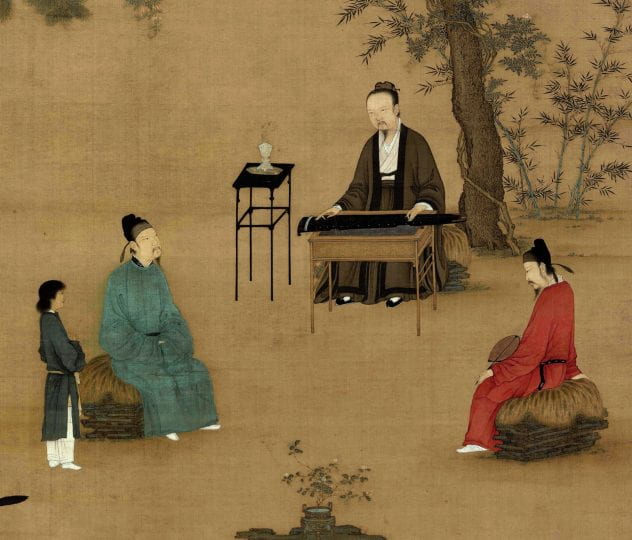
Chinese painting of three people arguing a case before a government official. Official is at desk, 2 plaintive sitting on cushions, one plaintive standing. A tree is in the background

Song Dynasty officials listening to guqin.

Anonymous

https://en.wikipedia.org/wiki/Culture_of_the_Song_dynasty#/media/File:Songhuizong_cropped_%E8%B5%B5%E4%BD%B6%E5%90%AC%E7%90%B4%E5%9B%BE%E8%BD%B4.jpg

Then there is a different kind of “law,” one that governs language and its use, the rules of grammar. John McWhorter in discussing the March Sisters in Little Women considers how “proper language” is not always proper, at least not by modern sentiments. In “‘Little Women’ and the Art of Breaking Grammatical Rules” he writes, “I’d like to dismantle the powerful but hopeless idea that language is something to be judged rather than observed. It can be hard to process, within the bounds of our lifetimes, the randomness of our take on what “proper” language is.” He goes on to point out “I always notice how characters talk, and one thing that sticks out about the March sisters is how often these ladies use “ain’t” in ways that their modern New England equivalents would not.” What we call improper English is not always improper. I remember reading a novel of Henry James (I think it was Daisy Miller, but I am not sure) and being taken aback when a character who would have known better, used the word “ain’t.” Just as words and their meanings change over time, so do grammar rules. We are less concerned with ending sentences with prepositions, using contractions in formal writing, using “their” as a first-person singular pronoun, because we do not have a first-person singular pronoun that is gender neutral.

In addition, language grows by invention. We make up words to say things we do not have words to say. Consider “artificial intelligence.” In what sense is it artificial? Is it false, fake, or insincere? These are all synonyms for “artificial.” In what sense is artificial intelligence, intelligent? I imagine some schoolteachers might consider artificial intelligence fake or false scholarship. But all this said, in the context of our time, we need a word or two that tells us the kind of thinking machines do.

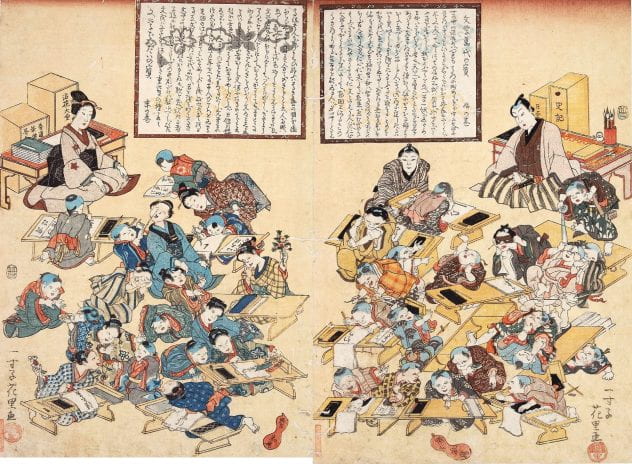
Painting of three teachers in a classroom of disruptive students

A class at terakoya (private educational school)

Issunshi Hanasato.

https://en.wikipedia.org/wiki/Woodblock_printing_in_Japan – /media/File:Bungaku-Bandai_no-Takara-Terakoya-School-by-Issunshi-Hanasato.png

In addition to breaking the rules of grammar (or as seems more likely, not breaking them as they were at the time) Alcott wrote in a diversity of genres and styles. Brenda Wineapple in “Stifled Rage” writes of Alcott:

(A)s a woman of imagination with considerable stylistic range, Alcott composed gothic tales, short stories, satires, fantasies, adult novels, poetry, memoirs, and essays in which she wrote of female independence and its costs in a restrictive domestic circle. She was also a prolific letter writer who converted into a tart prose style much of her anguish—and anger—at the circumstances in which she found herself, as a woman, as a dutiful daughter, as a second-class citizen, and, ironically, as a best-selling author who worked hard to maintain her popularity.

The article is a review of a book of Alcott’s essays. I was unaware of her range as a writer, knowing only that she wrote Little Women and Little Men. The image I had of her was of a somewhat conventional late 19th century woman, until I read Susan Cheever’s book American Bloomsbury which told the reader that Louisa May Alcott “was ill and in a rage” when she began to write Little Women. Wineapple’s review talks about Alcott’s beginnings as a writer:

She had begun to sell stories to help support her family, and though she’d already published two in the prestigious Atlantic Monthly, she also tried her hand at teaching again, despite her hatred of it. The publisher of The Atlantic, James Fields, loaned her forty dollars to help outfit her classroom, but when she came to him with another story—according to Rosenberg, “How I Went Out to Service”—he told her bluntly, “Stick to your teaching . . .  after the success of Little Women, Alcott paid back the loan, telling Fields she’d found that writing paid far better than teaching, so she’d stick to her pen. “He laughed,” she said, “& owned that he made a mistake.”

This suggests it was difficult for Alcott, as a woman, to be taken seriously as a writer. In the 2019 film Little WomenLaurie asks one of the March sisters, Amy, to marry him. Amy asks about the economics of the marriage if she says yes. Laurie responds saying we’re talking about love not money. Amy replies:

“Well. I’m not a poet, I’m just a woman. And as a woman, I have no way to make money, not enough to earn a living and support my family. Even if I had my own money, which I don’t, it would belong to my husband the minute we were married. If we had children they would belong to him, not me. They would be his property. So don’t sit there and tell me that marriage isn’t an economic proposition, because it is. It may not be for you but it most certainly is for me.”

Alcott didn’t write this, Greta Gerwig, the film’s director and script writer, wrote this. But I can imagine Alcott thinking this, she certainly expressed sentiments like this. In light of the difficulties women had earning their own living, it does not surprise me that she mastered several fictional forms. I was a bit surprised to find that she was an accomplished essayist as well as a storyteller, though even in the context of her time this should not have been surprising.

One thing that fascinates me about Alcott’s compositional range is that she had to master the language of each style. Perhaps that is not as significant a thing as I imagine, but the vocabulary of books about children, with children as readers in mind, would use a very different vocabulary from gothic tales and other kinds of stories with adult readers in mind, though this may say more about the range (or lack of range) of my vocabulary than the expansiveness of hers.


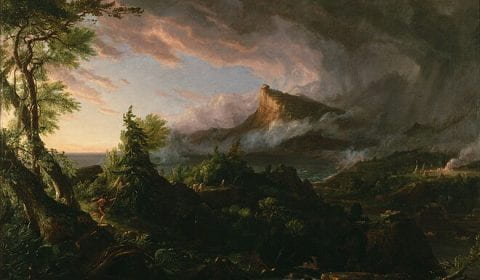
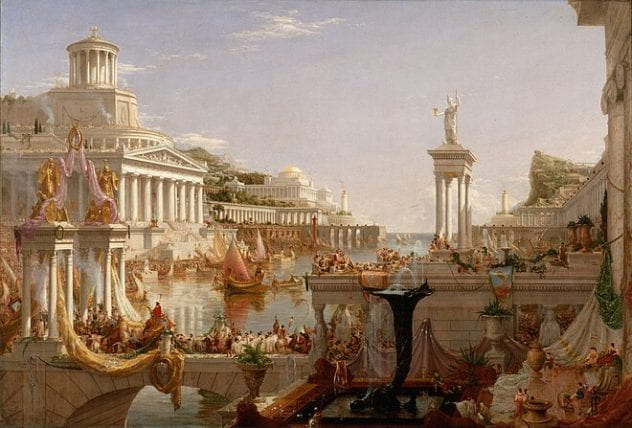
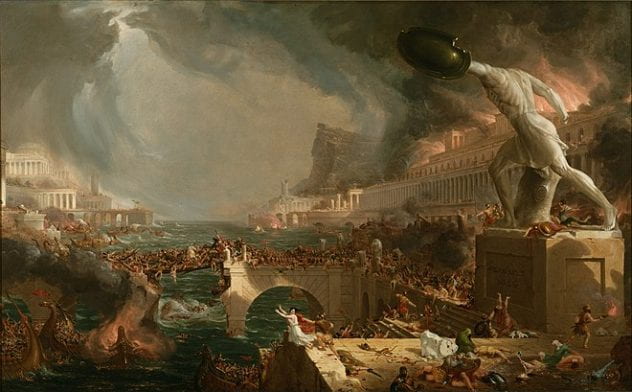
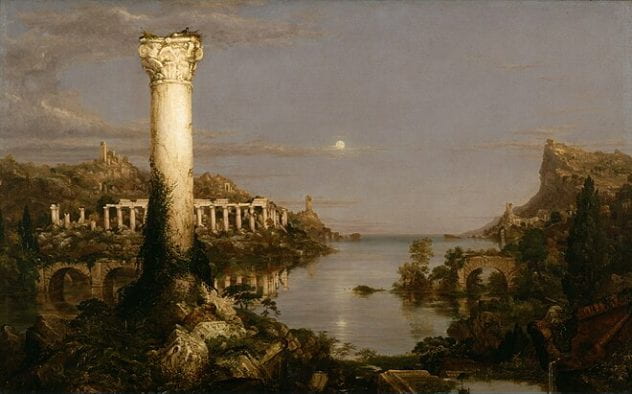
Painting of a forest wilderness

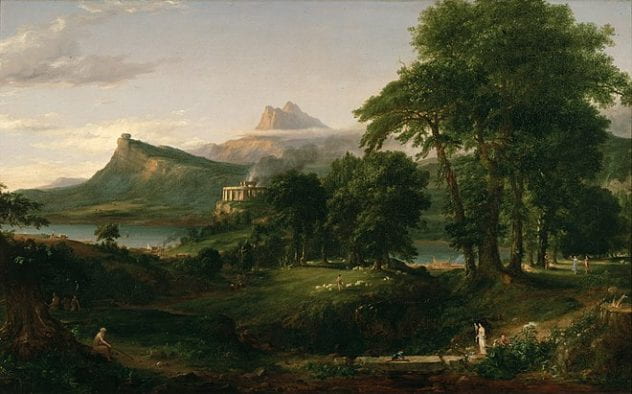
Painting of a forest with two people and a building a ways off from them.

Pointing of a Splendid Classical City with salutary, buildings, very many people and a harbor with ships

Painting of a classical city at war. It is on fire and there is much destruction

The remains of a destroyed city after a war, a tower, a ruined wall and the ruins of buildings.

Course of Empire (Series of Paintings)

Thomas Coles

https://en.wikipedia.org/wiki/The_Course_of_Empire_%28paintings%29

The five paintings above are a series by Thomas Coles that suggests the life and death of empires, and to a certain degree the cultures that shaped them. Though cultures die, the work of culture often survives, even some of its architecture may survive, Roman Aqueducts and the Coliseum, for example. Some of its visual arts, paintings and sculptures also survive, consider the Elgin Marbles. Lord Byron said of their being removed from the Parthenon:

But who, of all the plunderers of yon fane

   On high, where Pallas lingered, loth to flee

   The latest relic of her ancient reign—

   The last, the worst, dull spoiler, who was he?

   Blush, Caledonia! such thy son could be!

   England!  I joy no child he was of thine:

   Thy free-born men should spare what once was free;

   Yet they could violate each saddening shrine,

And bear these altars o’er the long reluctant brine. (Childe Harold’s Pilgrimage)


But we often learn most about a culture from the literature that survives, its poems and stories. Languages do and do not survive, no one speaks Anglo Saxon or Latin, and the languages that do survive, survive in a different form. Some forms may still be readable, Shakespearean English and that of the King James Bible, but the English of Chaucer takes a bit of work to master as does, to a lesser degree, the work of Thomas Malory. Terry Eagleton in his essay “Where Does Culture Come From” says of culture:

In Jude the Obscure, Jude Fawley finds himself living in Beersheba, the area of Oxford we know as Jericho, home at the time to a community of craftsmen and artisans who maintained the fabric of the university. It doesn’t take Jude long to realise that he and his fellow craftsmen are, so to speak, the material base without which the intellectual superstructure of the colleges couldn’t exist: without their work, as he says, ‘the hard readers could not read, nor the high thinkers live.’ He comes to recognise, in a word, that the origin of culture is labour. This is true etymologically as well. One of the original meanings of the word culture is the tending of natural growth, which is to say agriculture, and a cognate word, coulter, means the blade of a plough.

We live in a time where emphasis is often placed on “elites” and one of the elites some look down on and others admire is the elite of education. The educated often, though not always, have specialized jobs that pay well and for this reason others look down on the educated because they believe the educated look down on them, which some do. Of course, we are all members of one elite or another. I was apprenticed once as a carpenter, but because the only nail I could hit was on my foreman’s thumb, I did not last long in that profession. But it taught me that we are all masters of something, a craft, a skill, a profession, that most others have not mastered and for that reason all “elites” ought to respect all the other elites.

I do not think any culture, no matter how advanced could long survive if there were not elites that could dig ditches and lay pipe (I did this once in the Negev desert in August and have great appreciation for those that do this kind of work), or elites that could run cash registers or stock shelves (as well as order and pay for what is put on those shelves). Because we are dependent on each other we ought to be more respectful of each other and the needs of each other. We live in a culture that we value so it might be worth our while to consider the origin of the word “culture” as Eagleton points out to us, that it has its origins in agriculture and gives it name, or a cognate of it, to the plow that breaks the soil so the food that nourishes us can be planted. And those that do that work are among an “elite” that is not as highly respected by many as they ought to be.


Judgment at Nuremberg

Stanley Kramer

United Artists

In the film Tolkien there is scene where Tolkien is talking to a professor about language and how it is learned. There is more of course to a culture than language, but without language it is difficult to learn much about a culture. As a culture we often refer to cultures without written records as “prehistoric.” In taking about how language is learned, the professor begins very simply He points out a tree. A child asks her father what is that? The father tells the child it is an oak tree. The child learns two words “oak” and “tree.” The child will go on to learn there are many other kinds of trees. She will also learn that “oak” will begin as the name of a tree and then take on other characterizations, an “oak table”, a ship made of “oak.” And so on. We start out knowing very little about a word, but over time many words begin to take on many attributes and additional meanings and the circumstances of their use will often provide us with a more exact understanding of the word’s meaning and reach.

We began talking about law and the influence of literature on law and how literature by shaping language shapes law and in order to understand the law we need to have a sense for the meaning of the language at the time it was written, whether that be understanding the literal meaning of the law at the time it was written or the principles communicated by the language of the law at the time it was written. But there is another aspect to language and law, how the justices that interpret the law and the judges that use the law in sentencing bring their own eloquence and sense of language to their interpretations and judgements.

In the film clip the judge, played by Spencer Tracy, is passing judgment on other judges that committed war crimes in the way they enforced and interpreted the law during the Nazi regime in Germany during World War II. These judges are charged not for failure to enforce the law, but for enforcing it. The presiding judge begins his verdict by pointing this out saying “Conscious participation in a nationwide government’s organized system of cruelty and injustice is in violation of every moral and legal principle known to all civilized nations.” The power of this verdict is not solely in stating what the crime was, but the eloquence with which it is defined, and judgement is rendered. There is value in the heinousness of the crime being underscored by the power of the language that condemns it. There may be times we have to ask ourselves if the eloquence with which a law is interpreted is, though powerfully stated, inaccurate or just plain wrong. And conversely, just because the language that interprets a law is clumsy or banal does not mean that the interpretation itself is inaccurate. Language can be misleading not only because it is used incorrectly, but also because it used so well in defending something that is wrong.


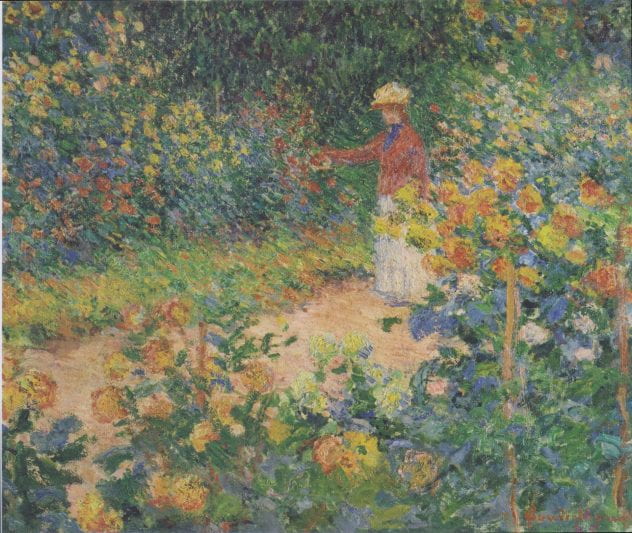
A woman Was;king through a lush garden

In the Garden

Claude Monet

https://en.wikipedia.org/wiki/Claude_Monet#/media/File:Monet_-_Im_Garten_-_1895.jpeg


Natalia Sylvester in “Some Words Feel Truer in Spanish” suggests the language we speak, especially when it is a second language, does not always have the best words for saying what we want to say. She points out that both languages shape each other, “We were making a new home here, same as so many immigrants who end up shaping language as much as it shapes us.” She talks about the difficulty moving between languages, finding correspondence between words in the one language in the other, “Some ideas are so embedded in Latin American and Spanish cultures that they exist implicitly. Of course, ‘ganas’ can be something you feel but also give, and be at once more tame yet more powerful than ‘desire.’ (If you know, you know.)” Of course, there may be a word in English that comes closer to Sylvester’s understanding of “ganas” that she has not yet learned. Or it may be that, like “pajamas,” it fills a space that is not yet filled in English, as Monet’s Impressionism tells us something about his garden that a more realistic rendering cannot.

Maria Popova in “The Dictionary of Obscure Sorrows”: Uncommonly Lovely Invented Words for What We Feel but Cannot Name” suggests another side of language, feelings we have we do not have words to express:

“Words are events, they do things, change things. They transform both speaker and hearer; they feed energy back and forth and amplify it. They feed understanding or emotion back and forth and amplify it,” Ursula K. Le Guin wrote in her exquisite manifesto for the magic of real human conversation. Each word is a portable cathedral in which we clarify and sanctify our experience, a reliquary and a laboratory, holding the history of our search for meaning and the pliancy of the possible future, of there being richer and deeper dimensions of experience than those we name in our surface impressions. In the roots of words we find a portal to the mycelial web of invisible connections undergirding our emotional lives — the way “sadness” shares a Latin root with “sated” and originally meant a fulness of experience, the way “holy” shares a Latin root with “whole” and has its Indo-European origins in the notion of the interleaving of all things.

Because we know their power, we ask of words to hold what we cannot hold — the complexity of experience, the polyphony of voices inside us narrating that experience, the longing for clarity amid the confusion. There is, therefore, singular disorientation to those moments when they fail us — when these prefabricated containers of language turn out too small to contain emotions at once overwhelmingly expansive and acutely specific.

We have all had the experience of not being able to find the word that accurately expresses what we are trying to say. I often suggest to students that there are many things they understand that their teachers and others think they do not understand because they do not have the vocabulary to express what they understand. They have the knowledge but not the words to communicate that knowledge, like someone who hears a symphony in their head but because they do not know the language of music, its notations and markings, they cannot put that music into a form that others, especially the musicians that would need to play it, can understand or hear.

But Popova’s point goes beyond this, to discuss areas of experience that lacks language that enables us to put that experience into words. There is a sense that we live by words, words define our perceptions of ourselves and our world. We may know what we are experiencing, but without language that defines it we are a bit at sea, we know, but we do not know. I may know what I am feeling but without the necessary language to communicate that to others I cannot be sure what that feeling or experience is.

The article is a review of a book, a dictionary, that invents words to describe the currently indescribable. For example, “dès vu (‘the awareness that this moment will become a memory’).” It is perhaps a flip side of “deja vu”. The dictionary she reviews looks to be a very interesting one. As she says, “Despite what dictionaries would have us believe, this world is still mostly undefined.” I am not sure though, that this problem can be solved by inventing what we think we might need. Language grows organically out of the needs of moments. One of the things that define a dead language as a dead language is that words are no longer being added to it as time and change make necessary. Living languages are growing languages, after all isn’t growth what defines something as “living.” I do not know if we can invent in advance our way out of linguistic needs. They need to be met by the imagination as the need arises. This is how languages grow, and they grow prodigiously. One need only compare the current edition of the Oxford English Dictionary with the first edition of that dictionary to see how many words have been added to the language in the course a hundred and some odd years, as well as the many words that have shifted or expanded their definitions. And if what one of my high school English teachers told me is true, all dictionaries are obsolete by the time they are published. Our language grows more quickly than our ability to capture it.


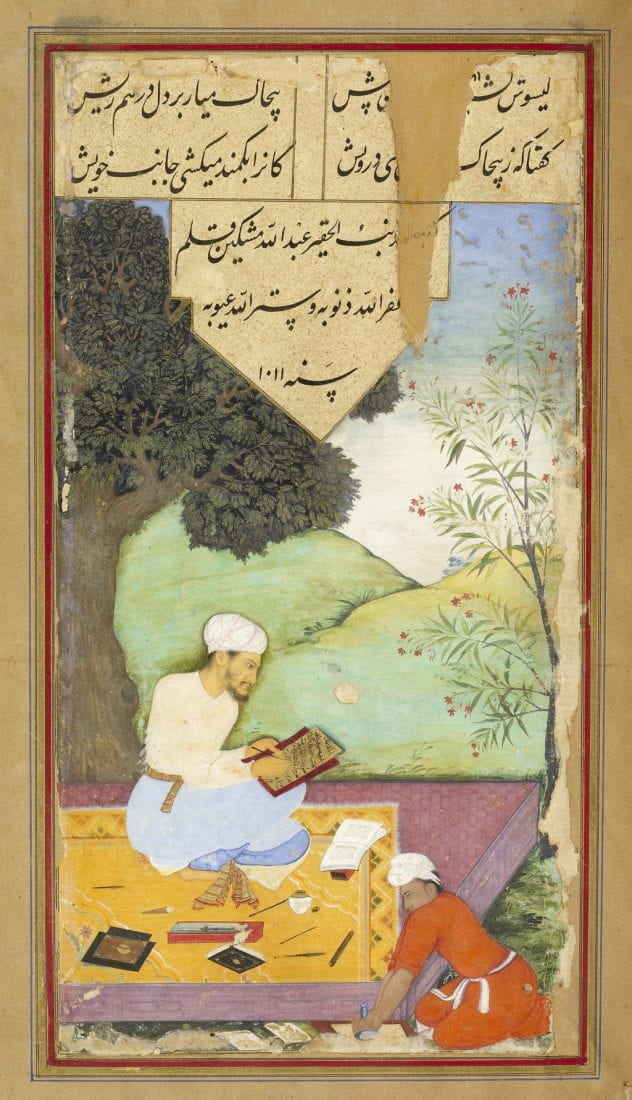
Painting of a Persian scribe writing

Portrait of the Scribe Mir ‘Abd Allah Katib in the Company of a Youth Burnishing Paper

 Attributed to Nanha

https://en.wikipedia.org/wiki/Scribe#/media/File:Amir_Khusraw_Dihlavi_-_Portrait_of_the_Scribe_Mir_’Abd_Allah_Katib_in_the_Company_of_a_Youth_Burnishing_Paper_-_Walters_W650187A_-_Reverse_Detail.jpg

Words in Their Finery


God Bless the Child
Blood, Sweat, and Tears

Words in Their Finery

Page from an illuminated manuscript of the Rubaiyat of Omar Khayyam, watercolor, bodycolor and gold leaf. Calligraphy and ornamentation by William Morris, illustrations by Edward Burne-Jones
William Morris and Edward Burne-Jones
http://en.wikipedia.org/wiki/File:Rubaiyat_Morris_Burne-Jones_Manuscript.jpg

The image is from an edition of the Rubaiyat of Omar Khayyam designed by William Morris and Edward Burne-Jones. We can see in this image that the beauty of words and of language lies not solely in what the words mean but in their appearance as well. Or at least that words can have a beauty that is independent of the meanings assigned to them by Dr. Johnson or Noah Webster. Morris realized that even if Chaucer had been an inferior poet the Elsmere Manuscript would still be a thing of beauty and worth preserving. The creating of typefaces is an art in itself and the quality of a typeface contributes to the pleasure derived from reading books. The song says, “momma may have, poppa may have, but God bless the child that’s got his own.” In a work of literature the author and the words used by the author may be the momma and the poppa of the story but the typeface has its own something to offer. The texture and quality of the paper and the design of the letters on the page contribute something important to the experience of reading a book.

When students write a paper they often want to use unusual, decorative fonts. This has to be discouraged, of course, because those students that go onto college will have professors who are not likely to appreciate papers that stray too far from the conventional in their use of fonts or typefaces. It is unfortunate that one of the stories we have to tell our children is to be careful of the clothes in which they dress the stories that they tell. Though the decorative fonts used by students in term papers are often garish and inappropriate to the stories that they tell, these fonts are none the less a part of the student’s expression and reveal a bit of her or his imagination at work. If the design of a thing is as important, some say it is more important, than the task the thing has been given to perform than fonts chosen by students reveal something of their imaginative life and they are certainly an important part of the design of the paper in the student’s mind.

“Trolls with an abducted princess, from the annual, and still published, fairy tale collection Bland Tomtar och Troll
John Bauer
http://en.wikipedia.org/wiki/File:John_Bauer_1915.jpg

There was a recent article in the Boston Globe, “How fairy tales pit adults against kids,” about fairy tales and the stories that they tell. The point of the article is that these stories are often seen by adults as dangerous and that in the stories themselves adults are often portrayed as the enemy or at best more of a hindrance than a help. Because the first audiences for these stories were adults one wonders how the adults that enjoyed them viewed children and childhood. There is a short story by H. G. Wells, “The Magic Shop,” that follows in the vein of some of these stories in that by the end of the story a child’s parents live in terror of their child. Wells’ story actually reverses the roles of adults and children in the traditional stories. In stories like “Sleeping Beauty” and “Hansel and Gretel” it is the children that live in fear of the adults. Wells’ story, though, ends less happily for the adults than the traditional stories do for the children in that in the traditional stories the children overcome the malevolent adult forces, in Wells’ story the malevolent child is still in control when the story ends.

Language is a magical tool. The same words can be employed by different people to convey very different messages. In fact, the same words in a single text can even be interpreted by different people to convey very different messages as well. I introduce my students to literary theory by showing them how The Tale of Peter Rabbit can be interpreted as a story about the importance of listening to your parents when read one way but also about the importance of disobeying your parents when read another way. This suggests perhaps that we take from the stories we read the messages we need to find in them in order to live more effectively. Does the author put meaning into a story or do readers place in them the meanings they need to find. This is perhaps the crux of the postmodern problem, does meaning exist, does meaning matter? And if meanings do exist and meanings do matter, who gets to decide what those meanings are and where and how those meanings are found?

Alice surrounded by the characters of Wonderland
Peter Newell
http://en.wikipedia.org/wiki/File:Alice_in_Wonderland.jpg

Perhaps no book has as much fun with the “meaning” of things than Lewis Carrol’s Alice books. Humpty Dumpty tells us words mean whatever we want them to mean. There is truth to this of course, because this is how new meanings to old words evolve and new words are invented. It is also how poets employ words. Anyone who has read a poem by Wallace Stevens or Bob Dylan has encountered this amorphous use of language. I often imagine that “Pale Ramon” struggles as much with meaning as he does with order in Wallace Stevens’ poem.

There were two article recently, one in the Washington Post, “Michael Dirda reviews the biography “The Mystery of Lewis Carroll,” by Jenny Woolf,” and one in the Guardian, “How the devastation caused by war came to inspire an artist’s dark images of Alice,” about the Alice stories and their creator. The Guardian article focuses on the illustrations that Mervyn Peake did for these books. He, a bit like Humpty Dumpty perhaps, in that he brought his experiences as a war correspondent during World War II to his interpretation of Carroll’s text through the illustrations he created. He makes the text mean what he wants it to mean, which in many ways is not unlike Carroll’s meaning. Carroll depicted a world at times in chaos due to the ways in which adults employed power, Peake was placed in a world where this chaos was brought to life.

Dirda’s review discusses a book about Carroll that focuses on Carroll’s conventional and unconventional qualities, part Mad Hatter and, perhaps, part Alice, who seems to me to be the most conventional character in the story; a conventional young lady to whom very unconventional things happen. The story often revolves around a deep desire to find meaning and order in a world in which none appears to exist. Though of course Carroll, a mathematician, has created a world with a chaotic zaniness on its surface that conforms, under the surface, to a fairly precise mathematical structure. Perhaps life, when looked at from within the experience of the person living it, appears random and bewildering, when it is in fact orderly and systematic when looked at from the outside, as from within our experience our planet and solar system is the center of the universe, but when looked at from a different vantage point our planet and solar system are found nearer to the edge of the universe. Our point of view and our understanding of reality are shaped more by our vantage point than by the context of that vantage point in the larger universe. If we do not know where we stand we will not be able to properly interpret what we see.

Alice in Wonderland
Walt Disney Pictures

This is the version of Alice in Wonderland that I grew up with, though how I viewed it as a child was very different from how I viewed it as a young adult. As a child in the 1950’s I saw it as a magical story with odd characters and vivid colors, but as a young adult in the 1960’s it took on shades of psychedelia. Vivid colors and the caterpillar’s hookah took on different connotations. The world of the 1960’s offered a very different vantage point from that of the 1950’s, though the different lenses through which I viewed the film may have had as much to do with my age than with the age in which I lived. I wonder how the counter-culture of the 1950’s viewed the film.

W. H. Auden once said, “There are good books which are only for adults because their comprehension presupposes adult experience, but there are no good books only for children.” I believe this is true, but I also believe that adults read children’s books with adult experiences that often shape the way these stories are perceived and they are changed by the adult mind into something different from what they where for the child that first read them. “The Little Engine That Could” and “Stone Soup” have different meanings for me now than they did when I was a child. I enjoyed how the soldiers tricked the townspeople in “Stone Soup” but I did not fully comprehend the point it made about generosity. In fact my views of generosity may have been shaped in part by this story without my being fully aware of how my views were being formed.

There is a Woody Guthrie song, “Pretty Boy Floyd” that talks about the outlaw leaving money under the supper dish after he has been given a free meal. I think stories often work this way, there is a gift left under the surface of our consciousness that we are often unaware of until long after we have enjoyed the story’s telling and the magic of the narrative has faded a bit. Sometimes we come back to the stories we read as children and find the messages that have shaped us and we are not always pleased with the way in which our views have been manipulated. This is the rhetorical nature of story telling. We are taken to a world that operates according to certain rules and we learn these rules as we journey through this world, but we bring them back with us to the world of our day to day lives.

Illustration of Alice with the White Rabbit
Arthur Rackham
http://en.wikipedia.org/wiki/File:Rackham_Alice.jpg

The White Rabbit tries to live in Wonderland according to the rules of Victorian English society and he is somewhat out of place there. The rules of Victorian England did not apply in Wonderland, or perhaps they did but without their veneer of respectability. What happens to Victorian society, or any “respectable” society, if the rules encountered in Wonderland are brought home to the world on the other side of the looking glass? Which looks quirkier the rules seen in their true light or the individual just back from Wonderland confronting those rules? Sometimes stories do this, they open our eyes to the way things truly are, but in opening our eyes put us at odds with our neighbors whose eyes remain closed and who do not wish to have them opened.


There’s a Word for It


Rhapsody in Blue
George Gershwin

There’s a Word for It

Word Painting
Measures 24-41 of the Tenor line of Every valley shall be exalted Handel’s Messiah
http://en.wikipedia.org/wiki/File:Every_Valley.jpg

Gershwin’s music captures the movement and the often fractious character of the American city. Woody Allen played this music under the opening sequences of his film Manhattan perhaps because New York City is among the most rambunctious and idiosyncratic of American cities, it often seems the city sees itself this way. Music can often tell stories, sometimes stories that language does not tell quite so well. Just as often, though, music is used in conjunction with language to tell stories more vividly than words or music alone could do.

I have always enjoyed the literary device of synesthesia. It is an under-noticed device I think, but it is used quite frequently. Whenever we refer to the clarity of sound as sound that is crystal clear we are using synesthesia, in that we are using a visual image, that of transparency, to describe an auditory image, a sound without distortion or interference. The image from the score of Handel’s Messiah captures another kind of synesthesia; it illustrates a kind of musical scoring that is called word painting. The music is sung to the words, “Every mountain and hill made low, the crooked made straight, and the rough places plain.” When the mountains are being made low, the music starts low and ascends, imitating the shape of the mountain then ends on a low not suggesting the mountain has been brought “low”. Similarly when the lyric talks about a “crooked” place the melody goes one note up and one note down (alternating “B” and “C” notes I think), suggesting a rough edge. And when the rough places are made plain, a single note is sung throughout the phrase suggesting a level surface. Of course this painting is not done with colors, at least not literal colors, but with sound. I enjoy this flexibility of language that describes a thing by making it into something it is not.

Salman Rushdie wrote an article for the London Times Literary Supplement, “Salman Rushdie celebrates the Paris Review”, in which he praises the English language for its great flexibility. He asked a jeweler friend of his why she liked working in gold and she told it is because the metal is so malleable that you can do almost anything with it. Rushdie sees the English language as being like that, pliable like gold and that is what makes it such a marvelous language for telling stories. Old English has a dark guttural sound to it that makes comedy difficult, Middle English has a musicality that makes tragedy difficult (perhaps just for me) but English as it is spoken today has both Old and Middle English elements to it that give real breadth to the possibilities of story telling.

Self-Portrait
Thomas Nast
http://en.wikipedia.org/wiki/File:Thomasnastselfportrait.jpg

The picture is a self-portrait caricature of Thomas Nast, America’s first editorial cartoonist. He used pictures and words to tell stories, as comics do to this day. He gave an additional meaning to the word “nasty”, a word that is much older than he. In the picture, Nast is sharpening his “sword” preparing for another strike. Nast used ridicule to show things up for what they were, in his view. Sir Walter Scott once said, “Ridicule often checks what is absurd, and fully as often smothers that which is noble.” This is the danger of ridicule and the editorial cartoon, I suppose. Nast’s targets were often folks like Boss Tweed and his corrupt cronies, but if he ever got it wrong, that satiric edge could do real harm, as it can to this day, whether employed in an editorial cartoon or some other venue.

In the case made against Socrates a reference was made to Aristophanes’ caricature of the philosopher to support their accusations. Aristophanes, in his play The Clouds, named his philosopher Socrates not because he was out to ridicule Socrates so much as philosophers in general and Socrates just happened to be the most visible philosopher of the day. The play is a great play, but it could be argued that if the ridicule it made of Socrates was undeserved than it is also a play that did some harm. Of course the same could be said of any work of art that was used for political purposes that had nothing to do with the real meaning of the work of art or the artist’s intent, at least to the degree that can be known. The artist is not always responsible for the way in which others misuse her or his work.

Con-Ed Explainers
Jules Feiffer
http://en.wikipedia.org/wiki/File:Conedexplainers.jpg

The cartoon relies almost exclusively on language, though the darkness and the candles make the joke work. You would have to know something about life in New York City in the 1950’s and 60’s to understand what is going on. Con Ed was the local supplier of electricity. They had a reputation for frequent power outages and rate increases and many felt that as the cost of the service went up, the quality of the service went down. The cartoon, though, underscores how simplicity in both the image as it is drawn and the language as it is used can make the most effective commentary.

Ocean Chart
Henry Holiday
http://en.wikipedia.org/wiki/File:Lewis_Carroll_-_Henry_Holiday_-_Hunting_of_the_Snark_-_Plate_4.jpg

Lewis Carroll was an inventor of words, mostly nonsense words but he was also adept at capturing the absurd at its most comical. The images above and below come from his poem The Hunting of the Snark. The story is thought by some to have introduced the word “snark,” along with its cognates, to the language. The image is a map of the sea and it captures with some accuracy what you are likely to see on the open sea, though its usefulness for navigational purposes is at best dubious. The joke works perhaps because it does capture what we expect to see in the open ocean and to those that do not navigate the map is as useful as any other while at sea. The second image captures a scene and is intended to illustrate (some think anyway, because the image does not appear with these words) the lines that accompany it (added by me and not the illustrator or publisher of the book).

To illustrate the lines (maybe):
They sought it with thimbles, they sought it with care;
They persued it with forks and hope;
They threatened its life with a railway-share;
They charmed it with smiles and soap.
Henry Holiday
http://en.wikipedia.org/wiki/File:Lewis_Carroll_-_Henry_Holiday_-_Hunting_of_the_Snark_-_Plate_6.jpg

Two prominent figures in the picture are a “careworn” young woman and a “hopeful” looking young woman, the “care” and “hope” referred to in the lines of the verse. Most everyone else has a fork of one kind or another in his hand. Everyone looks very serious and intent, with the possible exception of Hope. The sounds of the words in the rhyme are very serious sounds, though the meaning is of the words is nonsensical. I think this is an aspect of English story telling (though I am sure it is not exclusively English) that I enjoy, the ability of language to sound like one thing when it means something very different and the absurdity of this juxtaposition is what often creates humor in a text, it certainly does in this one. As was pointed out in the Rushdie essay referred to earlier, the English language is malleable and can be shaped in many ways to do many different things, even at times, things that are mutually exclusive, like serious comedy.

Paper Moon
Paramount Pictures

In this film clip we see another attribute of language, its ability to create a kind of verbal slight of hand that the con man can use to manipulate others. I think in the transaction the quick talker, Ryan O’Neal, came away with five dollars, but he may have gotten more, it all takes place so quickly. He is well away before the shopkeeper realizes that something isn’t quite right and even then she is not sure. The dexterous use of language can often achieve unexpected results. Like with many skills, those that use language well often appear to be doing something that is very easy, that anyone can do that is in fact quite difficult. Often in order for this skill to be effective, the person practicing it depends on the appearance of “simplicity” to be successful. As soon as the language is seen to be polished and complex, it becomes suspect and the readers or audience put up their guard, especially when it is language used by those like the Ryan O’Neal character in the film clip.

Language is how we communicate and the better our vocabulary and the more skilled we are at putting words together, the more effective we are at communicating our ideas. However, language is also inherently ambiguous, it means different things to different people. Often it succeeds by using images that lend themselves easily to multiple interpretations so that each hearer or reader can get from the words the message she or he wants to hear. This is often how a political speech works. But it is also how the words of a story enable each of us to use our imaginations in ways that make a story personal. There was an article in the Guardian, “Do you know what today’s kids need? Thumb amputation, that’s what,” about Maurice Sendak and his story Where the Wild Things Are. Sendak was asked what he would say to parents who were afraid their children would find the film version of his story “too scary”. Sendak replied, “I would tell them to go to hell.” For their children, he had the following message: “If they can’t handle it, go home. Or wet your pants. Do whatever you like.” Not a very sympathetic response from a writer of children’s stories.

The point of the article was that we need to be scared a little bit, especially if we are children. Sam Leith, suggests that the stories we most remember are the stories that frightened us. What makes these stories resonate is that they enable us to “leave home” without actually leaving home, to experience some of the dangers and “scariness” of the world while in a place of safety. We can experience danger without fear that we will actually be harmed by it. This serves a necessary purpose, in that it helps us as children to recognize danger before we actually have to experience it. We also learn how to respond to it after a fashion. We certainly learn that there are forces in the world that must be stood up to if the world is to spin merrily on its way through the universe.

Often we want to keep to children safe and this is a good thing, children by definition are probably not skilled enough to protect themselves in the “real world.” But if they are to ever be ready for the world they must learn what to expect and we always learn best from experience. Stories, especially scary stories, offer us a way to experience the dangers we might encounter in the world without actually experiencing them. They also force us to confront our courage, or sense of loyalty and friendship, or proper place in the world.

In the story Coraline, the central character experiences on the one hand a kind of abandonment by her parents, while at the same time she must accept the responsibility of rescuing them. There are two worlds in the story one safe, but indifferent to her, the other quite dangerous and desirous of her. Isn’t this how it often is in life, the people who seem to desire most our affection are the people that we can trust least with that affection and that the people that are most important to us, often take us the most for granted. Stories teach us that the most important people in our lives, those that we can most depend on, are often not the most exciting people. Because we know them well it is easy to take them for granted.

I enjoy the stories I read in English and I delight in the versatility of the language, but in part this is because English is the only language I know well. I suppose in part it is our familiarity with a language that makes it malleable, that makes it gold and that this quality of language is a product of being fluent in that language. All languages tell stories and they all work well in the cultures that these languages serve. But whatever malleable qualities other languages have I know and enjoy the malleable quality of the English language, that can terrify me in amusing ways and let me taste a sour expression.


The Same Old Song


Beethoven – Symphony #5 In C Minor, Op. 67 – 1. Allegro Con Brio
William Weller and the Birmingham Symphony Orchestra
Mendelssohn – Symphony No. 5 in D Major, Op. 107
Cesar Cantieri, London Symphony Orchestra

The Same Old Song

Still Life #20′, mixed media work
Tom Wesselmann
http://en.wikipedia.org/wiki/File:%27Still_Life_-20%27,_mixed_media_work_by_–Tom_Wesselmann–,_1962,_–Albright-Knox_Gallery–.jpg

There was an article in this Sunday’s Boston Globe on the cliché. It was called “Let us now praise… the cliché”. The article points out that often clichés convey bits of useful information and folk wisdom quickly and somewhat universally, universal at least to the culture that created the cliché. The opening to Beethoven’s Fifth Symphony has become a bit of a musical cliché, in that it is well known and carries a certain meaning that listeners are quick to recognize, it has in a way become a cliché for Beethoven’s symphonic work and classical music in general. The work itself is not clichéd, or at least it wasn’t when it was first performed but it has evolved into one. The clip from Mendelssohn that accompanies the Beethoven clip employs a musical cliché of sorts from the Protestant Reformation, Martin Luther’s hymn “A Mighty Fortress Is Our God.” Because this piece of music is so recognizable it conveys quickly a musical idea that gives its name to the symphony as a whole, it is often referred to as the Reformation Symphony.

The painting also makes use of clichés. The door to the cupboard above the sink suggests Chairman Mao’s Little Red Book being a red square (a cliché in and of itself) with a white star, the symbol of Communist China. The white bread, a cliché for wholesomeness, placed strategically next to another grain product that is a bit less wholesome. Then there is the Coca Cola glass, which is another cultural icon/cliché. The Piet Mondrian painting above the bananas is also a bit iconic, especially as it is representative of a kind of modern abstract painting. These components of the painting, because they are clichés, convey quickly a certain depth of meaning to the viewer that enables the painting to succeed as a comment on American culture of the early 1960’s. The painting is from 1962, before the Vietnam War dominated “popular culture.” The colors and the “product placement” suggest the conflict between Communism and Capitalism or perhaps the consumer culture of America.

As a teacher of writing I am usually encouraging my students to avoid clichés. Because clichés are by definition overused they tend to reflect badly on a piece of writing and make the writer appear to be a bit unimaginative. I am not sure that it is always necessary to find a new way of saying something that can be said effectively by a more commonplace phrase, but that is the “conventional wisdom.” As the article points out, many clichés are still around because they “say best what needs to be said” and we will have to wait and see if any of the substitutes writers struggle to invent will go on to become as successful, though, as the music of Beethoven may suggest, this success is something of a “two edged sword”.

It also important to be careful with clichés and how we use them. Sometimes clichés are used as a way of avoiding a real problem or of ignoring an impending problem or, perhaps, as a way of avoiding a little extra work. “Why”, for example, “reinvent the wheel” may be a way of avoiding the work of reinventing something that needs to be reinvented. We do not, after all, use wagon wheels on automobiles, so at some point it was indeed necessary to reinvent the wheel and it may not always be easy to tell which came first the “automobile” or the “reinvented wheel.” Some will tell us “if it ain’t broke, don’t fix it.” But just because a thing is not currently broken does not mean it is not in the process of breaking and a bit of preventative maintenance may be “just the ticket.” A cliché, like any piece of writing, needs to be judged by the circumstances in which it is employed. Some may always be dubious, but others may at times still serve a useful purpose. It is also very difficult, at times, to find a phrase that is not on some level clichéd. Is, for example, the phrase “serve a useful purpose” a cliché? Is it an over used expression? Some might think so. Others may see in it an avenue to a more economical compositional style.

The Mona Lisa (or La Joconde, La Gioconda)
Leonardo da Vinci
http://en.wikipedia.org/wiki/File:Mona_Lisa.jpg

The paintings above and below are not unlike the two pieces of music, one having become a cliché and the other playing games with clichés. It is a danger for an artist who does something too well that that something may eventually become a cliché. Leonardo da Vinci is almost a Renaissance cliché in and of himself. He is often pointed to as the definition of the Renaissance, an inadequate definition in that he did not represent all areas of cultural advancement with which the Renaissance is associated but probably he was adept at enough of them to make the comparison work. C. S. Lewis said, “For it must be noticed that such dominance (the dominance of a literary form in any given age) is not necessarily good for the form that enjoys it. When everyone feels it natural to attempt the same kind of writing, that kind is in danger. Its characteristics are formalized. A stereotyped monotony, unnoticed by contemporaries, but cruelly apparent to posterity, begins to pervade it.” This is often the fate of the cliché, whether in painting, music, literature, or any other art form. It is because Beethoven’s Fifth (or the opening anyway) has become clichéd that the music often evokes a comic response when there is not necessarily anything comic in the music. Or is there? Was Beethoven being a bit over dramatic to serve a kind of satiric purpose in the music? Does the musical cliché it has become serve the musical purpose for which it was created? I am not sure. I do not think there is a comic intent behind the Mona Lisa but it has devolved a bit into “kitsch” because of the place it holds in the culture.

The Disquieting Muses
Giorgio de Chirico
http://en.wikipedia.org/wiki/File:The_Disquieting_Muses.jpg

The painting by Chirico plays with iconic forms from classical art for comic purposes and, probably, social commentary as well. It also plays with allusions to classical culture when it plays with the muses from Greek and Roman myth. There is the juxtaposition of the castle, a Renaissance cliché with the factory, a modernist cliché. The muse in the background appears as a conventional human likeness while the muses in the foreground have . . . well I am not certain what they have for heads. The colored box suggests the motley costume of the clown Pierrot from the Comedia del Arte. But are these in fact clichés or are they archetypes or symbols that add richness and do not in any way detract? For an icon of any kind to work it must be readily identifiable with that which it represents and it is this quick identification that gives it power. The issue is not so much the cliché as it is its use, is it a kind of laziness that enables us to avoid thinking deeply about something by letting the cliché do the thinking for us, or does it evoke ideas that lend a bit of depth to the issue being examined.

Plan Nine from Outer Space
Ed Wood

Ed Wood enjoyed a moment of popularity a few years back when a film biography was made about him. But what made Wood an attractive subject for this film was the excruciating excess of cliché and poor production techniques that characterized his films. These excesses made them comic, though comedy was not the Wood’s intent when he made the films. From the clip it can be seen how on one level there is almost a Monty-Python-esque humor to them. The characters are so over-blown and caricatured that it is difficult to take them seriously. Groucho Marx once said of Margret Dumont that she was the perfect foil for the comedian because she did not get the jokes. Others disagree with this assessment, but perhaps it has some truth in regards to Ed Wood, maybe he was a film comedian who did not get his own jokes.

Still, the problem with Ed Wood and taking him seriously as a filmmaker is that he did not seem to understand when a film convention had been overused. Films are full of clichés and conventions, even very good ones. Sometimes these are used to point the viewer in the direction of the filmmakers influences, as when Harrison Ford makes his way across the bottom of the German truck in The Raiders of the Lost Ark. Spielberg is paying a complement to John Ford by evoking a scene from one of his films, Stagecoach, where John Wayne does something similar traveling underneath a stagecoach. It works like an allusion in literature to an earlier piece of writing. These allusions add richness to the film as they add richness to a poem or story. It is not necessary to understand the allusion for the scene to work, but it gives an additional level of pleasure to those that understand the allusion. They remind us that most works of art are produced by a culture that has a cultural heritage full of symbols, archetypes, and images that connect the parts of the culture to the whole.

Front Cover for the LP Sgt. Pepper’s Lonely Hearts Club Band by the artist The Beatles.
The cover art copyright is believed to belong to EMI Records, Ltd.
http://en.wikipedia.org/wiki/File:Pepper%27s.jpg

If we look at the images that fill the album cover of The Beatles record Sergeant Pepper’s Lonely Heart’s Club Band we will see figures from throughout the culture, including an early version of The Beatles behind the more current incarnation of the album’s release. But amongst the crew that surrounds them are comedians and cowboys and film stars; writers, scientists, and clergy. There does not seem to be much that is left out. What is the point of putting all these images into the cover? Does it make a commentary on the music or is it just there to catch the eye of the record buyer to help sell the record? Often clichés are comfortable because whether they serve a real purpose or not they do not usually ask much of us or even if they do, it is not that difficult to avoid the work they invite us to perform by just focusing on the cliché itself. This is perhaps the ultimate weakness of the cliché, that even if it is intended to serve a higher purpose and the writer or artist is not being lazy in the use of the cliché, it is still very easy for the reader or viewer to be lazy in her or his interpretation of it.


A Passionate Discipline


God Bless the Child
Blood, Sweat, and Tears

A Passionate Discipline

The Arnolfini Portrait
Jan van Eyck
http://en.wikipedia.org/wiki/File:Jan_van_Eyck_001.jpg

The song celebrates the child that knows what she or he wants and is able to get whatever that is. The lyric just says “God bless the child that’s got his own” but I think the thing to have is self-knowledge and the skills necessary to achieve the heart’s desire. Perhaps the song means something different but that is what I think. In an English class the thing to have is the ability to use language well, or the potential that can be shaped into that ability. Not everyone in English class aspires to be a writer, but the English class aspires to make competent writers of everyone. The goal may be seem an unrealistic one to the student, one that makes too many demands on the student, but it is seen as an achievable goal by most English teachers.

Writing as a craft or an art is a very different thing from writing as a skill. I have great admiration for anyone who can tell a story and has the discipline to put that story into a book and then to get that book published. It is a thing that is very difficult to do. There was an article in The Guardian this past week about the writer Dan Brown whose new book The Lost Symbol was published this past week. The article, “True confession: I don’t hate Dan Brown”, is about the reaction Dan Brown’s books often receive from those that write “literature” or “serious fiction and/or non-fiction.” The author of the article, Jean Hannah Edelstein, does not care much for Brown’s books, but is grateful that he brings people into bookstores and gets people excited about reading who might not otherwise get excited about reading and some of these people will go on to read “serious stuff.”

The painting suggests the importance of craft and discipline for the artist. It is a realistic painting that attempts to capture the reality of the scene it portrays down to the reflection in the mirror at the back of the room. The painting, I was told once in an art class, was a kind of marriage certificate and that the scene was not in fact a realistic portrayal of the people in the painting, but a goal for their marriage. The woman in the painting is pregnant. According to the story told by my art teacher she was not in fact pregnant at the time the painting was done, but that was the couple’s hope for the near future. But that said, the painting looks real and is meticulous in its attempt to capture all the little details of the room and the people in it (and also the dog). For the artist that painted the painting this may have just been a commission, a piece of work over which he had few feelings beyond the receipt of his fee. His subject, after all, was chosen for him.

The artist, whether a writer, a painter, a musician, or a worker in some other medium, has to find a balance between passion and polish. If the subject is chosen for the artist, the task becomes one of finding the passion that will give life to the work. If the subject is chosen by the artist passion is probably not the problem, the problem is finding the discipline and the skill to shape that moment of passionate inspiration into something meaningful and “finished.” Wordsworth defined poetry as “emotion recollected in tranquility.” This suggests to me that the effective poet is able to capture an emotion after that emotion no longer has power over her or him; it is a recollection of an emotional moment after the moment has passed. This recollection must evoke the emotion in the poet without the poet being dominated by it.


The Dot and the Line
Metro-Goldwyn- Mayer

The film captures the essence of artistic discipline. The squiggle is inspiration without form or control. The line, on the other hand, was uninspired but in firm control, at least initially. He is not without passion; he just does not have the tools to give expression to his emotions. The line, though, finds inspirations and brings control and form to that inspiration. He is in the grips of a powerful emotion, love, and while he uses that passion to inspire his work and to motivate him to do his artistic work, the passion does not control his expression. This is, I think, the essence of the artist’s struggle, though, the degree of freedom from that passion may not always be absolute. There may be a conversation between the passion and the intellect that controls the process and polishes the rough edges.

The Yellow House
Talkback Thames

In this film depicting a painting expedition of Vincent Van Gogh and Paul Gauguin it is clear one painter is in the grips of passionate inspiration and the other is not. Gauguin paints deliberate lines and is in absolute control of what he does and what he does has little interest to the viewer. Van Gogh on the other hand seems to be in the grips of powerful emotion and his end product is one the viewer wants to see in greater detail than the glimpse that is given. Van Gogh helps himself control the process by constructing a kind of grid through which he looks but other than that he creates with a good bit of spontaneity and freedom.

Of course, this is a cinematic portrayal of what the director believes the moment was like, but that does not guarantee that the film got it right. It may be that the director, who meticulously controlled the action of the scene, created an effect that agreed with what he imagined the moment to be like, but that effect may have been fathered not by the facts of the moment but by what the director’s romantic imagination suggested to him were the facts of that moment. But is art necessarily concerned with truth or does it create its own truth.

Drawing of Purkinje cells (A) and granule cells (B) from pigeon cerebellum
Santiago Ramón y Cajal
http://en.wikipedia.org/wiki/File:PurkinjeCell.jpg

The painting below and the drawing above both use lines on a piece of paper to suggest the way things work. The image above attempts to illustrate the workings of a pigeon’s brain. The image below depicts the norns, characters from Norse myth who, like the fates in Greek myth, weave a person’s destiny. The lines that run through the drawing are the threads that will make the tapestry that will capture the destiny of the tapestry’s object, the person whose destiny is being cast. I wonder if there is a connection between the lines that illustrate the synapses of the brain and the lines in the tapestry that illustrate a person’s fate.

I have always enjoyed stories that are illustrated. I think the illustrator’s art often adds new dimensions to the storyteller’s art. These dimensions are not always found in the story but if the illustrations are done well, these dimensions were certainly evoked by the story. Tolkien said that he removed a giant’s shoes because he liked the illustration of a barefoot giant more than his description of the giant wearing boots. Sometimes, evidently, the illustrator may influence the direction aspects of the story take. On the other hand there is the story of Seymour. Dickens was hired to write a story around the popular artist’s illustrations. The public, however, preferred Dickens’ story to Seymour’s drawing and Dickens was given the freedom to take the story where he wished. The humiliation led to Seymour’s suicide. Art can be a dangerous business.

Norns weaving destiny
Arthur Rackham
http://en.wikipedia.org/wiki/File:Nornsweaving.jpg

There was an article in the Boston Globe this weekend about books and music and how books rarely evoke music. The article, “Pynchon on shuffle”, was about how Thomas Pynchon created a soundtrack of music from the 1960’s to play behind the events of his story. Most of the songs are real and those who lived through this moment in time recognize them, but many are of his own invention and serve his artistic purposes. But why is it that some art forms are more friendly with one another than others. Why do words and pictures go together so well, and why do words and music when joined in song go together so well, but not words apart from music, words that are not sung but only evoke what might be sung?

I do not think there should be such antipathy between the written word that might be spoken and the written word that was written to be sung. There is often music in the sounds of words and many books to be fully appreciated need to be read aloud. We expect this to be true of poetry but it is often true of prose as well. I think, for example, The Great Gatsby is a very musical text when read aloud. Storytelling began as a spoken art, we ask someone to “tell” us a story and not to “write” us a story (unless of course we are English teachers). The first stories, The Iliad and The Odyssey for example, were not written down until much later, originally they were performed, sung, to their early audiences. Perhaps one day, when the technology allows, books will have their own internal jukebox so that they will sing to us again.

Rosebud
Kay Nielsen
http://en.wikipedia.org/wiki/File:Kay_Nielsen00a.jpg

I have always enjoyed the illustrations of Kay Nielson. In this image from the Grimm’s Brother’s story of “Snow White” or “Rosebud” as they called it (or at least as it was called in this edition of the tale), we see an overgrown castle and a prince awakening the sleeping princess. The lines appear in the background and I wonder if they are not the threads of fate woven by the norns in the earlier illustration. Perhaps they are just shafts of light suggesting the first light of morning but they add a nice stylized touch to the image. And being a picture of Snow White, it is difficult not to imagine the story without the soundtrack of the film playing in the background. The title of the painting also evokes another film, a different kind of fairy tale, Citizen Kane, a film in which a different rosebud had a place of prominence. Music and story may not be intimate friends but as stories become films their soundtracks, the music that plays behind the action, become a part of our experience of the story and are often difficult to separate from the story when we are getting the story from the printed page rather than from the silver screen.

Again, though, is the art of the cinema an art that proceeds from passion, as with Van Gogh and his painting in the film clip earlier, or is it one that proceeds from commission, like the painting at the top. A director does not always chose his scripts; actors do not always chose their roles. What part of the process is passion being controlled by a disciplined mind and what part is a disciplined mind seeking out the passion. Can art be the product of a dispassionate process that exerts the artist’s skill on the process without the artist’s emotional involvement? Can the artist be emotionally detached from the work and still produce a work of artistic merit? Can a work of artistic merit be produced without emotional detachment? How much of this painting is unbridled passion and how much is careful control of the painter’s medium? The painter’s emotions emanate from this painting, but the painting is not a squiggle, there is a disciplined hand at work.

Wheat Field with Crows
Vincent Van Gogh
http://en.wikipedia.org/wiki/File:Vincent_van_Gogh_(1853-1890)_-_Wheat_Field_with_Crows_(1890).jpg